


Few shop-floor failures are more frustrating than turning a long drive shaft to tight runout tolerances, milling the keyway as the final operation, and watching the shaft bend out of straightness before it even reaches inspection. When a shaft bows after keyway milling, the problem is rarely a dull cutter or a loose vise. In most cases, it is locked-in residual stress inside the steel bar.
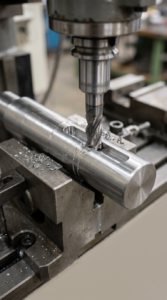
Selecting the right raw material condition before machining prevents post-milling straightening, scrap losses, and assembly misalignment. Below is a practical metallurgical and machining comparison of cold-drawn bright bars, peeled bright bars, and hot-rolled black bars in machined condition for keywayed and slotted shafts.
Why Do Cold-Drawn Steel Shafts Bow After Keyway Milling?
Cold-drawn bright bars bow after keyway milling because die drawing traps high circumferential tensile stress in the outer surface layer, and cutting an asymmetric keyway breaks that internal force balance.
During cold drawing, a hot-rolled bar is pulled through a tungsten carbide die at room temperature. The outer skin elongates more than the center core, creating a self-balancing stress ring: high tensile residual stress near the surface balanced by compressive stress in the interior. As long as the bar remains radially symmetrical, those opposing forces cancel out and the bar stays straight.
The moment a milling cutter slices a keyway, flat, or deep spline along one side of the shaft, it removes a strip of that stressed outer skin. The unreleased tensile stresses on the opposite side immediately pull the shaft into a concave bow toward the milled keyway. On shafts over 500 mm in length, runout deviation can easily jump by 0.15 mm to 0.50 mm.
Cold Drawn vs. Peeled vs. Machined Black Bars: How Each Behaves
While cold-drawn bars offer higher yield strength for heavy roughing cuts, peeled bars and pre-turned black bars eliminate asymmetric keyway distortion because they remove the outer skin by cutting rather than plastic deformation.
1. Cold-Drawn Bright Bars (+C)
Cold-drawn bars are pickled to remove mill scale and drawn through a precision die to achieve ISO h9, h10, or h11 tolerances. Cold work hardening increases yield strength by 30% to 60% and ultimate tensile strength (UTS) by 15% to 25% compared to hot-rolled stock.
- Heavy Cut Advantage: Because cold drawing raises yield strength and UTS, a cold-drawn bar resists permanent bending under high radial cutting tool pressure and accepts a deeper depth of cut for the same diameter than softer peeled or black bars.
- Chip Breaking & Concentricity: Work-hardened surface ductility produces cleaner, shorter chips during deep turning cuts, while tight concentricity eliminates interrupted-cut shock on carbide inserts.
- Keyway Limitation: Unless ordered in the stress-relieved condition (+C +SR), cutting deep or long asymmetric keyways releases hoop stress and bows the shaft.
2. Peeled Bright Bars (Centerless Turned, +SH)
Peeled bars are produced on high-speed centerless peeling machines where rotating carbide heads shave 1 mm to 3 mm off the outer diameter of hot-rolled stock, followed by precision straightening (and optional centerless grinding).
- Zero Locked-In Hoop Stress: Because material is removed by cutting rather than radial compression, peeled bars have virtually no circumferential residual stress and stay straight after keyway milling.
- Complete Decarburization Removal: Peeling strips away surface seams, rolling laps, and the decarburized skin, ensuring uniform surface hardness if the shaft is later induction hardened.
- Delivery Condition Constraint: Centerless peeling is almost always performed when the steel is in a softer condition (as-rolled, normalized, or annealed). As a result, peeled bars have lower yield strength than cold-drawn bars and require slightly lighter roughing depths of cut on slender shafts to avoid tool-pressure deflection.
3. Hot-Rolled Black Bars in Machined Condition
Buying hot-rolled black bars and rough-turning the outer diameter in-house achieves the same stress-free core behavior as a peeled bar once the outer skin is removed.
- Metallurgical Equivalence to Peeling: Turning away the hot-rolled surface on a CNC or engine lathe removes uneven mill-cooling stresses and decarburization before keyway milling begins.
- When It Makes Sense: Ideal for stepped shafts with large diameter drops, diameters above cold-drawing limits, or components requiring pre-hardened quenched-and-tempered (+QT) alloy steel (such as EN19 or EN24) that is too hard for standard mill peeling.
- Shop-Floor Trade-Offs: Higher raw material wastage (10% to 20% turned into chips), abrasive mill scale that wears inserts on the first pass, and higher CNC machine hours compared to starting with pre-peeled bright bars.
Comparison Table: Cold Drawn vs. Peeled vs. Machined Black Bars
| Parameter | Cold-Drawn Bright Bars (+C) | Peeled Bright Bars (+SH) | Black Bars (Turned In-House) |
|---|---|---|---|
| Surface Stress State | High circumferential tensile residual stress (unless stress-relieved) | Virtually stress-free (outer skin shaved by cutters) | Stress-free once outer hot-rolled layer is turned off |
| Distortion After Keyway Milling | High risk of bowing on long or deep keyways | Minimal to none (holds straightness) | Minimal to none (if turned symmetrically before milling) |
| Resistance to Tool Pressure & Depth of Cut | Highest: Elevated yield strength & UTS allow heavier cuts without bending | Moderate: Typically supplied in softer condition; requires balanced cut depths | Moderate to High: Depends on whether supplied annealed or +QT |
| Surface Decarburization | Compressed (not removed) | Completely removed | Completely removed after rough turning |
| Dimensional Tolerance | ISO h9 / h10 / h11 ready out of rack | ISO h9 / h10 / h11 (h8 if ground) | Requires full OD turning to reach tolerance |
| Chip Loss & CNC Cycle Time | Lowest scrap and fastest cycle time | Low scrap; ready for finish operations | Highest chip loss and lathe time |
How to Choose the Exact Bar Condition for a Keywayed Shaft
Use this practical decision checklist before issuing a purchase order for shafting steel:
- Choose Standard Cold-Drawn Bright Bars (+C): When your shaft has short, shallow keyways (length under 15% of total shaft length), low length-to-diameter ratio (L/D < 10), or requires heavy rough turning passes on concentric sections where elevated yield strength speeds up metal removal.
- Choose Stress-Relieved Cold-Drawn Bars (+C +SR): When you need tight ISO h9 bright-bar tolerances and high yield strength, but have a medium-length keyway where standard cold-drawn stock would bow.
- Choose Peeled (or Peeled & Ground) Bright Bars (+SH): When manufacturing long motor shafts, pump shafts, gearbox shafts, or spline shafts (L/D > 12) with full-length or deep keyways, or when the shaft requires subsequent induction hardening without soft spots.
- Choose Hot-Rolled Black Bars (Machined In-House): When the shaft features heavy steps requiring deep stock removal anyway, exceeds 80–100 mm diameter, or must be machined from pre-hardened quenched-and-tempered (+QT) alloy steel.
Shop-Floor Precautions When Milling Keyways
- Complete All OD Turning Before Milling Keyways: Never leave heavy OD roughing cuts until after the keyway is milled; interrupted cutting across an open slot causes tool chatter and uneven stress redistribution.
- Use Sharp Cutters and Climb Milling: Dull end mills generate localized frictional heat and compressive smearing along the keyway floor, inducing fresh bending stress even in peeled bars.
- Support Long Shafts Properly: Use a full-length V-block or hydraulic steadies under the keyway zone rather than clamping only at the ends, preventing downward deflection under vertical milling pressure.
- Leave 0.15 mm to 0.25 mm Grinding Allowance on Critical Shafts: For precision bearing journals, finish-grind the outer diameter after keyway milling to remove any micro-runout.
Explore how different bar finishes perform across engineering sectors on our Uses & Applications page, or check standard grade mappings on our Steel Grade Cross-Reference guide.
Source Precision Cold-Drawn, Peeled & Hot-Rolled Bars from Steelmet Industries
Steelmet Industries manufactures and supplies Cold Drawn Bright Steel Bars, peeled and turned bars, stress-relieved bright bars, and Hot Rolled Steel Bars across carbon and alloy grades including EN8, C45, EN19, EN24, and SAE 1018. Every batch is backed by full metallurgical traceability under our Quality Policy.
Discuss Your Shafting or Bright Bar Specification:
Corporate Website: www.steelmet.in
Request a Quote: Contact Steelmet Industries
