


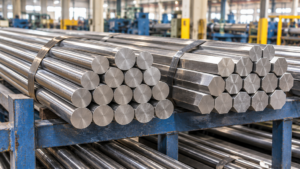
C45 (1.0503) and C45E (1.1191) are two of the most widely specified medium-carbon unalloyed engineering steels under European standards (EN 10083-2 and EN ISO 683-1). Known for balanced tensile strength, wear resistance, and machinability, both grades serve as core materials for shafts, spindles, gears, axles, studs, and induction-hardened machine components.
Although engineers and buyers often treat C45 and C45E as interchangeable, they differ in one critical metallurgical detail: steelmaking purity (sulfur and phosphorus limits). Choosing C45E over standard C45 can prevent surface cracking during high-frequency induction hardening and improve fatigue life in dynamically loaded parts.
At Steelmet Industries, we supply C45 and C45E in hot-rolled black bars, forged rounds, and precision cold-drawn bright steel bars (rounds, hexagons, squares, and flats) backed by full mill test certification. Below is a practical technical comparison to help you specify the right grade.
C45 vs. C45E vs. C45R: What Do the Suffixes Mean?
Under EN 10083-2 (Steels for quenching and tempering), the base designation C45 indicates a non-alloy quality steel with a nominal carbon content of 0.45%. The suffix letters define how the steel was refined and tested:
- C45 (Material No. 1.0503): Standard non-alloy quality steel. Allows up to 0.045% maximum sulfur and 0.045% maximum phosphorus. Suitable for general mechanical parts, normalized shafts, and standard quenched-and-tempered components.
- C45E (Material No. 1.1191): Special steel (“E” stands for Edelstahl / special quality). Refined to restrict both sulfur and phosphorus to 0.030% maximum (0.035% in older EN 10083-2 revisions). This cleaner microstructure reduces non-metallic sulfide inclusions, making C45E the preferred choice for induction hardening and high-fatigue rotating shafts.
- C45R (Material No. 1.1201): Controlled-sulfur variant of special steel C45E, containing a deliberate sulfur window of 0.020% to 0.040% to improve chip breaking and tool life during high-speed CNC turning and drilling.
Chemical Composition Comparison: C45 (1.0503) vs. C45E (1.1191)
Both grades share identical target ranges for carbon, silicon, manganese, and residual alloying elements. The sole compositional distinction is the tighter control over tramp impurities (P and S) in C45E:
| Element | C45 (1.0503) % | C45E (1.1191) % | C45R (1.1201) % |
|---|---|---|---|
| Carbon (C) | 0.42 – 0.50 | 0.42 – 0.50 | 0.42 – 0.50 |
| Manganese (Mn) | 0.50 – 0.80 | 0.50 – 0.80 | 0.50 – 0.80 |
| Silicon (Si) | 0.40 max | 0.40 max | 0.40 max |
| Phosphorus (P) | 0.045 max | 0.030 max | 0.030 max |
| Sulfur (S) | 0.045 max | 0.030 max | 0.020 – 0.040 |
| Chromium (Cr) | 0.40 max | 0.40 max | 0.40 max |
| Molybdenum (Mo) | 0.10 max | 0.10 max | 0.10 max |
| Nickel (Ni) | 0.40 max | 0.40 max | 0.40 max |
Note: Combined Cr + Mo + Ni content must not exceed 0.63% under EN 10083-2 / EN ISO 683-1.
Mechanical Properties of C45 & C45E Steel
Because C45 and C45E are unalloyed medium-carbon steels, their hardenability is limited by section thickness (ruling section). As bar diameter increases, core cooling rates during quenching slow down, reducing attainable yield and tensile strength:
1. Quenched and Tempered Condition (+QT)
| Diameter / Ruling Section | Yield Strength (Re) Min | Tensile Strength (Rm) | Elongation (A) Min | Charpy Impact (KV) Min (C45E only) |
|---|---|---|---|---|
| Up to 16 mm | 490 MPa | 700 – 850 MPa | 14% | 25 J (at +20°C) |
| > 16 mm to 40 mm | 430 MPa | 650 – 800 MPa | 16% | 25 J (at +20°C) |
| > 40 mm to 100 mm | 370 MPa | 630 – 780 MPa | 17% | 25 J (at +20°C) |
2. Normalized (+N) & Cold-Drawn Bright Bar (+C) Conditions
| Supply Condition | Diameter Range | Yield Strength (Re) Min | Tensile Strength (Rm) | Typical Hardness |
|---|---|---|---|---|
| Normalized (+N) | 16 mm – 100 mm | 305 MPa | 580 MPa min | 170 – 210 HB |
| Cold Drawn (+C) | 10 mm – 16 mm | 565 MPa | 710 – 1030 MPa | 210 – 300 HB |
| Cold Drawn (+C) | > 16 mm – 40 mm | 500 MPa | 650 – 1000 MPa | 195 – 290 HB |
| Cold Drawn (+C) | > 40 mm – 63 mm | 410 MPa | 630 – 950 MPa | 190 – 280 HB |
Note: Cold-drawn mechanical values follow EN 10277 (Bright steel products). Cold drawing work-hardens the bar surface and raises yield strength without thermal heat treatment.
International Equivalent Grades for C45 & C45E
When cross-referencing global engineering drawings, C45 and C45E correspond closely to the following international standards:
| Standard / Country | Equivalent Grade | Notes |
|---|---|---|
| DIN / EN (Europe) | C45 (1.0503) / C45E (1.1191) | Formerly Ck45 under older DIN 17200 |
| AISI / SAE (USA) | SAE 1045 / AISI 1045 | Standard 0.45% medium-carbon steel |
| BS 970 (UK) | 080M46 / EN8 / EN8D | EN8 (080M40) has 0.40% C nominal; 080M46 matches 0.45% C |
| IS 1570 (India) | C45 / 45C8 | Standard Indian medium-carbon steel |
| JIS G4051 (Japan) | S45C | Widely used in Japanese automotive & tooling |
| GOST (Russia) | 45 | Direct carbon-percentage designation |
Review full cross-standard mappings on our DIN Specifications and SAE Specifications pages.
Heat Treatment Guidelines for C45 and C45E
Proper thermal cycles allow C45 and C45E to achieve either maximum core strength or a hard wear-resistant outer case:
- Normalizing: Heat to 840°C – 880°C, hold until uniform temperature is reached, and cool in still air. Refines grain structure after forging or hot rolling.
- Soft Annealing: Heat to 650°C – 700°C, soak thoroughly, and cool slowly in the furnace (max hardness ~207 HB) to maximize machinability before heavy CNC operations.
- Through Hardening (Quenching): Austenitize at 820°C – 860°C. Quench in water for larger sections or oil/polymer for thinner sections and complex shapes to minimize distortion.
- Tempering: Reheat immediately after quenching to 550°C – 660°C depending on target tensile strength, hold for at least 1 hour per 25 mm of section, and cool in air.
- Flame & Induction Hardening: Rapidly heat the surface layer to 850°C – 880°C followed by immediate water or polymer spray quenching, achieving a surface hardness of 53 – 60 HRC with a tough, unhardened core. C45E (1.1191) is strongly recommended for induction hardening due to its low inclusion content.
Machinability & Weldability
- Machinability: Rated at approximately 55% to 65% relative to free-cutting steel (1212). Cold-drawn C45 bright bars (+C) provide clean chip formation and tight ISO h9/h11 tolerances for CNC turning, milling, and thread rolling.
- Weldability: Fair to moderate. Because carbon content sits around 0.45%, rapid cooling after welding can form brittle martensite in the heat-affected zone. Preheat components to 200°C – 300°C, use low-hydrogen electrodes, and perform stress-relief annealing at 550°C – 600°C immediately after welding.
Industrial Applications of C45 & C45E Bright Bars
Explore our Uses & Applications overview to see how C45 and C45E are deployed across key industries:
- Power Transmission & Machinery: Motor shafts, pump shafts, lead screws, spindles, couplings, and splined axles.
- Gears & Sprockets: Medium-duty spur gears, pinions, chain sprockets, and induction-hardened gear racks.
- Automotive & Agricultural Equipment: Connecting rods, wheel hubs, tie-rod ends, pins, and hydraulic piston rods (induction-hardened and hard-chrome plated).
- Fasteners & Tooling: High-tensile studs, anchor bolts, die bolsters, mould plates, and clamping fixtures.
Frequently Asked Questions on C45 & C45E Steel
1. When should I specify C45E (1.1191) instead of standard C45 (1.0503)?
Specify C45E whenever your component undergoes induction hardening, flame hardening, or high-cycle fatigue loading. Its lower sulfur and phosphorus limits (0.030% max) minimize sulfide stringers that can act as crack initiation sites during rapid surface quenching.
2. Is C45 the exact same steel as EN8?
They belong to the same medium-carbon engineering steel family and are often used for similar applications, but their nominal carbon ranges differ slightly. Standard BS 970 EN8 (080M40) has 0.36% to 0.44% carbon (0.40% nominal), whereas C45 (1.0503) has 0.42% to 0.50% carbon (0.45% nominal), giving C45 slightly higher achievable hardness after quenching.
3. What is the maximum hardness C45E can achieve after induction hardening?
Properly induction-hardened and water-quenched C45E typically reaches a surface hardness of 55 to 60 HRC (roughly 580 to 690 HV), depending on frequency, power density, and carbon content within the 0.42% – 0.50% band.
4. Does Steelmet Industries supply C45 and C45E in cold-drawn bright bar form?
Yes. We supply C45 and C45E in cold-drawn, peeled, and turned bright bars across rounds, hexagons, squares, and flats, as well as hot-rolled and forged rounds for larger diameters.
Source Certified C45 & C45E Bright Bars from Steelmet Industries
Steelmet Industries manufactures and supplies precision Cold Drawn Bright Steel Bars and hot-rolled bars in C45 (1.0503) and C45E (1.1191) with ISO h9, h10, and h11 tolerances. Every batch is supplied with full mill test certificates, chemical and mechanical reports, and adherence to our Quality Policy.
Request a Quote or Technical Consultation:
Corporate Website: www.steelmet.in
Send Your Requirement: Contact Steelmet Industries
