


When designing a shaft, gear, or heavy-duty wear pin, specifying “58 HRC hardness” on an engineering drawing without defining the hardening route and base steel grade is an expensive mistake. Reaching 58 HRC by gas carburizing a low-carbon alloy bar produces a completely different stress profile, core toughness, and distortion pattern than induction hardening a medium-carbon bright bar or through-hardening an alloy steel.
Choosing the wrong combination leads to either over-engineering (paying for long furnace carburizing cycles when fast induction hardening would suffice) or premature component failure (sub-surface case crushing or brittle fracture under shock loads). Below is a practical engineering guide to matching case hardening, induction hardening, and through hardening to the right steel grades.
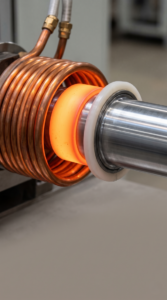
How the Three Hardening Methods Differ Metallurgically
Case hardening diffuses extra carbon into a low-carbon steel surface, induction hardening rapidly heats and quenches the existing carbon in a medium-carbon steel surface, and through hardening transforms the entire cross-section into tempered martensite.
1. Case Hardening (Carburizing & Carbonitriding)
Case hardening starts with a low-carbon steel (typically 0.14% to 0.22% C) that cannot harden deeply on its own. Components are heated to 900°C – 930°C in a carbon-rich atmosphere so carbon diffuses into the outer layer (typically 0.5 mm to 2.0 mm deep), followed by quenching and low-temperature tempering (150°C – 200°C).
- Resulting Microstructure: A high-carbon martensitic outer shell (58 – 62 HRC) backed by a ductile, tough low-carbon core (28 – 42 HRC) with beneficial compressive residual stresses at the surface.
- Typical Steel Grades: 16MnCr5, 20MnCr5, SAE 8620, EN36C (832M13), EN32B (080M15), and SAE 1018 (for light-duty carbonitriding).
2. Induction Hardening (Surface Flame / Coil Hardening)
Induction hardening does not change the steel’s chemistry. Instead, it uses a medium-carbon or medium-carbon alloy steel (0.38% to 0.50% C) that already contains enough carbon to harden. A high-frequency copper coil heats only the outer skin (1.0 mm to 5.0 mm deep) above its austenitizing temperature in seconds, followed immediately by polymer or water spray quenching.
- Resulting Microstructure: A hard martensitic wear layer (54 – 60 HRC) over an untouched normalized or pre-toughened core, with minimal thermal distortion because the core stays cool and rigid.
- Typical Steel Grades: EN8D (080A42), C45E (1.1191), EN9 (070M55), and EN19 / SAE 4140 (42CrMo4).
3. Through Hardening (Quenching & Tempering / +QT)
Through hardening heats the entire component uniformly to 820°C – 860°C, quenches it in oil, polymer, or water, and tempers it at 450°C – 650°C to balance hardness and impact toughness across the full cross-section.
- Resulting Microstructure: Uniform tempered martensite from surface to center (typically 28 – 45 HRC / 280 – 440 HB for structural shafts, or up to 55 – 62 HRC for high-carbon tool and bearing grades).
- Typical Steel Grades: EN8 (080M40), C45, EN19 (SAE 4140), EN24 (SAE 4340), and EN31 (SAE 52100).
Comparison Table: Case Hardening vs. Induction Hardening vs. Through Hardening
| Parameter | Case Hardening (Carburizing) | Induction Hardening | Through Hardening (+QT) |
|---|---|---|---|
| Base Carbon Content | Low Carbon (0.14% – 0.22% C) | Medium Carbon (0.38% – 0.50% C) | Medium to High Carbon (0.36% – 1.00% C) |
| Common Steel Grades | 16MnCr5, 20MnCr5, SAE 8620, EN36C, EN32B | C45E, EN8D, EN9, EN19 (4140) | EN8, C45, EN19 (4140), EN24 (4340), EN31 |
| Surface Hardness | 58 – 62 HRC | 54 – 60 HRC | 28 – 45 HRC (up to 60 HRC in high-C grades) |
| Core Condition | Tough, ductile core (28 – 42 HRC) | Unchanged (As-rolled, normalized, or +QT core) | Hardened uniformly throughout section |
| Typical Case Depth | 0.5 mm – 2.0 mm (follows complex gear teeth) | 1.0 mm – 5.0 mm (deep wear & bending resistance) | Full cross-section (100% through) |
| Thermal Distortion Risk | High: Long soak at 920°C requires finish grinding | Low: Cold core supports shaft geometry | Moderate to High: Depends on quench severity & geometry |
| Selective Area Hardening | Difficult (requires copper plating or stop-off paint) | Easy: Hardens only journals, lobes, or teeth | Not possible (entire part is heated) |
Component-by-Component Selection: Shafts, Gears & Pins
1. Transmission Gears, Pinions & Splines
Best Choice: Case Hardening (16MnCr5, 20MnCr5, SAE 8620, EN36C)
Gear teeth experience two simultaneous stresses: severe sliding contact wear at the pitch line and high bending fatigue at the tooth root. Carburizing 20MnCr5 or SAE 8620 provides a 60 HRC wear-resistant skin that follows every tooth profile uniformly, while compressive surface stresses prevent root bending fatigue cracks. For heavy mining or shock-loaded drivetrain gears, upgrade to nickel-chromium EN36C for maximum core impact toughness.
2. Long Motor Shafts, Pump Shafts & Hydraulic Piston Rods
Best Choice: Induction Hardening (C45E, EN8D, EN19)
Carburizing a 1,500 mm hydraulic piston rod or stepped motor shaft at 920°C causes severe warping and leaves the entire bar too hard to straighten easily. Instead, starting with peeled or ground C45E (1.1191) or pre-toughened EN19 (+QT) bright bars and induction hardening only the bearing journals or outer rod skin delivers 55 – 58 HRC wear resistance with minimal runout distortion. Note that for induction hardening, clean special-quality steels like C45E or peeled bars free from surface decarburization are essential to prevent soft spots and quench cracking.
3. High-Tensile Tie Bars, Axles, Bolts & Heavy Structural Shafts
Best Choice: Through Hardening (EN19 / 4140, EN24 / 4340, EN8)
When a component carries high torsional, tensile, or bending loads across its entire cross-section rather than localized sliding wear, through hardening is the right route. EN19 (42CrMo4) and EN24 (34CrNiMo6) quenched and tempered to 280 – 340 HB deliver high yield strength and fatigue endurance throughout thick diameters without requiring expensive post-heat-treatment cylindrical grinding.
4. Pivot Pins, Bushings & Cam Rollers
Best Choice: Case Hardening (20MnCr5 / EN32B) or Through-Hardened Bearing Steel (EN31)
For heavy excavator and linkage pins subjected to high impact shock, case-hardened 20MnCr5 prevents brittle snapping. For small-to-medium precision rollers and bushings operating under pure rolling contact without shock bending, through-hardened high-carbon chromium steel (EN31 / SAE 52100) offers maximum compressive wear life.
Quick Decision Checklist Before Ordering Steel
- Need 58 – 62 HRC surface hardness on complex shapes (gears, sprockets, dog clutches) with shock toughness? Specify case-hardening alloy grades like 16MnCr5, 20MnCr5, or EN36C.
- Need 55 – 60 HRC wear resistance on specific journals or long shafts without furnace distortion? Specify induction-hardening grades like C45E (1.1191), EN8D, or EN19 in peeled or ground bright bar condition.
- Need uniform core strength (800 – 1100 MPa tensile) across thick sections for shafts, studs, or axles? Specify through-hardening alloy steels like EN19 (SAE 4140) or EN24 (SAE 4340).
- Want to eliminate in-house heat treatment distortion altogether? Order pre-hardened and tempered (+QT) bright bars or peeled bars ready for finish machining.
Review international grade equivalents on our Steel Grade Cross-Reference page, or see how different heat-treated grades perform across industries on our Uses & Applications guide.
Source Heat-Treatable Bright & Black Steel Bars from Steelmet Industries
Steelmet Industries supplies tested Cold Drawn Bright Steel Bars, peeled and ground bars, and Hot Rolled Steel Bars across case-hardening, induction-hardening, and through-hardening grades including 16MnCr5, 20MnCr5, C45E, EN8D, EN19, and EN24. Every dispatch includes full chemical and mechanical certification under our Quality Policy.
Consult Our Metallurgical & Sales Team:
Corporate Website: www.steelmet.in
Request a Quote: Contact Steelmet Industries
