


In high-volume component manufacturing, paying for solid round or flat steel bar only to mill 30% to 55% of that metal into turnings and swarf is one of the biggest hidden drains on profitability. Not only are you paying full per-kilogram steel prices for metal that ends up in the scrap bin, you are also tying up CNC milling centers, carbide end mills, and operator hours on rough stock removal.
For recurring asymmetric cross-sections—such as D-shafts, keyway bars, pawl profiles, chamfered flats, T-sections, and custom polygonal bars—switching from standard round stock to custom cold-drawn special steel profiles eliminates bulk milling entirely. Below is a practical engineering and cost comparison to help you decide when custom cold-drawn profiles beat CNC machining from standard bars.
What Are Custom Cold-Drawn Special Steel Profiles?
Custom cold-drawn special profiles are precision steel bars drawn through shaped tungsten carbide dies to match a component’s exact two-dimensional cross-section before cutting to length.
Instead of starting with a round or rectangular bar and milling longitudinal slots, steps, or chamfers on every single part, the cross-sectional geometry is formed continuously across the entire 3-meter to 6-meter bar length at room temperature. Once delivered to your machine shop, production drops to simple operations: saw-cutting to width, drilling cross-holes, tapping, or light finish grinding.
At Steelmet Industries, custom cold-drawn profiles are produced across carbon and alloy engineering steels—including SAE 1018, EN8 (C45), EN1A, 16MnCr5, 20MnCr5, and EN19 (SAE 4140)—with tight dimensional tolerances (typically ±0.05 mm to ±0.15 mm depending on profile complexity) and smooth, scale-free bright surfaces.
Why Machining Complex Profiles from Standard Round Stock Hurts Margins
Machining asymmetric shapes from round bars wastes 25% to 55% of purchased steel weight, accelerates milling cutter wear, and induces asymmetric clamping and cutting distortion.
- High Raw Material Chip Loss: When milling a flat-sided pawl, wedge, or D-section from a round bar, you must buy a diameter large enough to circumscribe the widest corner—turning nearly half the bar into low-value scrap chips.
- Bottlenecked CNC Milling Capacity: Longitudinal profile milling requires multiple roughing and finishing passes along the full part length, consuming expensive VMC (Vertical Machining Center) spindle hours.
- Interrupted Cuts & Tool Breakage: Hogging heavy flats or deep grooves out of round stock subjects end mills to interrupted entry shocks, shortening insert life and requiring frequent tool offsets.
- Post-Milling Bowing & Burrs: Removing heavy metal from one side of a standard cold-drawn round bar releases surface residual stresses, bowing long parts and leaving heavy exit burrs that require secondary deburring.
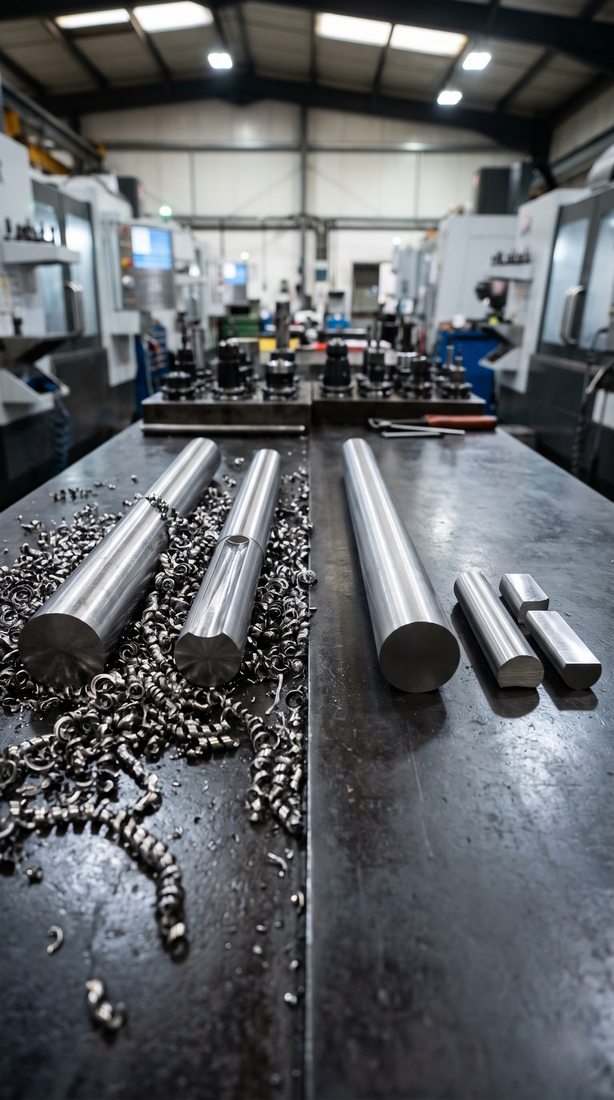
Side-by-Side Comparison: Custom Cold-Drawn Profiles vs. Round Stock Machining
| Evaluation Factor | Custom Cold-Drawn Special Profiles | CNC Machining from Standard Round / Flat Stock |
|---|---|---|
| Material Utilization (Yield) | 85% – 95% (near-net cross-section; scrap limited to saw kerf & cross-holes) | 45% – 75% (25% – 55% of bar weight lost as milling chips) |
| CNC Cycle Time per Part | 40% – 70% Faster: Longitudinal profile milling is completely eliminated | Baseline (Slowest): Requires full-length roughing & finishing passes |
| Surface Finish & Tolerance | Bright cold-drawn finish (Ra 0.8 – 1.6 μm) with tight profile tolerances out of the rack | Requires dedicated finish-milling passes to achieve smooth flat/groove walls |
| Mechanical Strength & Grain Flow | Continuous cold-worked grain flow follows profile contours; higher yield strength & surface hardness | Machining cuts across grain fibers, exposing core structure at milled corners |
| Upfront Tooling Cost | Requires custom tungsten carbide drawing die investment (amortized over production volume) | Zero custom die cost: Uses standard off-the-shelf round or flat bars |
| Best Suited Production Volume | Medium to high recurring annual volumes (typically 3 to 5+ metric tons/year) | Prototypes, one-off spares, and low-volume batches |
High-ROI Industrial Components Made from Cold-Drawn Profiles
Whenever a part has a uniform cross-section along its length and is produced in recurring batches, cold-drawn special shapes deliver immediate per-piece savings:
- Automotive & Two-Wheeler Components: Door latch pawls, gearshift forks, alternator pole shoes, steering rack blanks, caliper guide pins, and D-cut actuator shafts.
- Electrical Switchgear & Power Hardware: Pole pieces, busbar clamps, rotor wedges, and precision terminal blocks requiring sharp corners and flat contact faces.
- Textile, Printing & Packaging Machinery: Guide rails, cam bars, gripper jaws, and shuttle components where long, straight, wear-resistant sections are essential.
- Industrial Locks, Hinges & Hand Tools: Deadbolt blanks, cylinder cam bars, spline keys, and wrench jaw profiles.
- Agricultural & Construction Equipment: Wear strips, scraper blades, cutter-bar fingers, and keyed linkage pins.
When Should You Switch to Custom Cold-Drawn Profiles? (Decision Checklist)
Use these four practical criteria to evaluate whether an existing CNC-machined part is a strong candidate for custom cold drawing:
- Constant 2D Cross-Section: The part has a uniform profile along its primary axis (flats, keyways, grooves, chamfers, radii, or tapers) that can be saw-cut into individual pieces.
- High Chip-to-Part Ratio: You are currently milling away more than 20% of the starting round or flat bar weight to form the outer shape.
- Recurring Production Demand: Annual steel requirement is at least 3 to 5 metric tons (or recurring quarterly schedules), allowing the one-time tungsten carbide die cost to pay for itself within the first one to two production runs.
- Need for Cold-Worked Strength: Cold drawing increases yield strength and surface hardness by 15% to 40% over annealed stock, often eliminating secondary surface hardening on moderate-wear components.
Explore our Uses & Applications overview to see how precision cold-finished shapes serve diverse OEM sectors, or check grade equivalents on our Steel Grade Cross-Reference guide.
Develop Custom Cold-Drawn Profiles with Steelmet Industries
Steelmet Industries manufactures precision Cold Drawn Bright Steel Bars and custom-engineered special profiles tailored directly to your 2D component drawings. From initial die design and sample bar approval to full-scale production lots in carbon and alloy steels, every dispatch is backed by strict dimensional inspection and mill test certification under our Quality Policy.
Send Your Component Drawing for a Feasibility & Cost Evaluation:
Corporate Website: www.steelmet.in
Request a Quote: Contact Steelmet Industries
