


When specifying high-tensile quenched-and-tempered alloy steels for heavy-duty shafts, gears, studs, or axles, engineers almost always narrow their choice down to two benchmark grades: EN19 (BS 970 709M40 / AISI 4140 / 42CrMo4) and EN24 (BS 970 817M40 / AISI 4340 / 34CrNiMo6).
Because both steels share roughly 0.40% carbon, chromium, and molybdenum, buyers often assume EN24 is simply a “stronger version” of EN19. In reality, on bar diameters under 50 mm quenched and tempered to standard 850–1000 MPa (R/S/T) conditions, EN19 and EN24 deliver nearly identical tensile strength—while EN24 costs significantly more due to its 1.30% to 1.80% nickel addition. Knowing exactly when EN19 is sufficient and when EN24 is metallurgically mandatory prevents both unnecessary material spend and catastrophic brittle fracture in thick sections.
The Core Metallurgical Difference: What Nickel Adds to EN24
EN19 is a chromium-molybdenum (Cr-Mo) alloy steel, whereas EN24 adds 1.30% to 1.80% nickel to become a nickel-chromium-molybdenum (Ni-Cr-Mo) grade with deeper hardenability and superior low-temperature impact toughness.
In plain carbon steels (like EN8 or C45), rapid water quenching is required to form martensite, and hardening penetrates only a few millimeters beneath the surface. Adding chromium and molybdenum in EN19 slows down the transformation to soft pearlite/bainite, allowing oil quenching to harden sections cleanly up to roughly 60 mm to 100 mm in diameter.
Adding nickel in EN24 pushes hardenability even deeper—allowing uniform core hardening in massive diameters up to 150 mm to 250 mm—while simultaneously toughening the ferrite/martensite matrix so the steel resists shock fracture at sub-zero temperatures.
Chemical Composition Comparison: EN19 vs. EN24
| Element | EN19 (709M40 / AISI 4140 / 42CrMo4) % | EN24 (817M40 / AISI 4340 / 34CrNiMo6) % | Metallurgical Effect |
|---|---|---|---|
| Carbon (C) | 0.36 – 0.44 | 0.36 – 0.44 | Sets maximum attainable martensitic hardness (~55 – 58 HRC as-quenched) |
| Manganese (Mn) | 0.70 – 1.00 | 0.45 – 0.70 | Improves hardenability and binds residual sulfur into harmless MnS |
| Silicon (Si) | 0.10 – 0.35 | 0.10 – 0.35 | Deoxidizer; enhances temper resistance |
| Chromium (Cr) | 0.90 – 1.20 | 1.00 – 1.40 | Increases depth of hardening, wear resistance, and temper strength |
| Molybdenum (Mo) | 0.25 – 0.35 | 0.20 – 0.35 | Eliminates temper embrittlement and boosts high-temperature creep strength |
| Nickel (Ni) | None (Residual ≤ 0.40) | 1.30 – 1.80 | Dramatically increases deep-section hardenability and sub-zero Charpy toughness |
| Sulfur & Phosphorus (S & P) | 0.035 max each | 0.035 max each | Kept low (even cleaner in VD-route steel) to prevent fatigue crack initiation |
Ruling Section & Mechanical Properties: Where EN19 Drops Off and EN24 Holds
For ruling sections up to 63 mm, EN19 and EN24 achieve similar tensile ranges (850 – 1000 MPa), but above 100 mm diameter, EN19 suffers core strength drop-off while EN24 maintains uniform strength and higher Charpy impact values.
Under BS 970 / EN 10083-3 standards, quenched-and-tempered mechanical properties depend heavily on the limiting ruling section (the maximum diameter that achieves the specified core strength during oil quenching):
| Property / Condition | EN19 (AISI 4140) | EN24 (AISI 4340) |
|---|---|---|
| Condition T (850 – 1000 MPa UTS) Max Ruling Section | Up to 100 mm diameter | Up to 250 mm diameter |
| Condition U (925 – 1075 MPa UTS) Max Ruling Section | Up to 63 mm diameter | Up to 150 mm diameter |
| Condition V (1000 – 1150 MPa UTS) Max Ruling Section | Up to 29 mm diameter | Up to 100 mm diameter |
| Condition W (1075 – 1225 MPa UTS) Max Ruling Section | Not recommended (brittle risk) | Up to 63 mm diameter |
| Charpy V-Notch Impact (at +20°C, Condition T) | ~50 – 55 Joules min | ~55 – 65+ Joules min |
| Sub-Zero Impact Toughness (-20°C to -40°C) | Drops noticeably below -20°C | Superior: Retains high impact energy down to -40°C |
Machinability, Weldability & Heat Treatment Shop-Floor Comparison
- Machinability: In the annealed condition (~200–225 HB), EN19 machines roughly 10% to 15% faster than EN24. Nickel in EN24 makes the ferrite matrix tougher and slightly gummier, increasing cutting forces and requiring rigid tooling and positive-rake carbide inserts. In pre-hardened (+QT, 28–32 HRC) bright bar condition, both grades turn and mill cleanly when supplied in vacuum-degassed (VD) quality.
- Induction Hardening Response: Both grades respond well to surface induction hardening (reaching 54 – 58 HRC), making pre-toughened EN19 (+QT) an industry favorite for induction-hardened hydraulic piston rods and bearing journals.
- Weldability: Neither grade is meant for casual structural welding due to high carbon equivalent (CEV > 0.75). If repair or assembly welding is unavoidable, both require strict preheating to 250°C – 350°C, low-hydrogen electrodes, and immediate post-weld stress relieving at 550°C – 600°C.
- Raw Material Cost: Because of its 1.5% nickel content and stricter mill refining, EN24 typically costs 20% to 35% more per kilogram than EN19.
Decision Guide: When to Specify EN19 vs. EN24
Choose EN19 (AISI 4140 / 42CrMo4) When:
- Finished component diameter is under 80–100 mm and target strength is 850–1000 MPa (Condition T).
- You are manufacturing standard CNC-turned drive shafts, induction-hardened hydraulic rods, high-tensile studs (ASTM A193 B7), spindles, or medium-duty gears.
- Operating temperatures remain above -20°C and cost competitiveness is critical.
Choose EN24 (AISI 4340 / 34CrNiMo6) When:
- Component cross-section exceeds 100 mm diameter (forged shafts, heavy press tie-bars, large pinions) and requires uniform core strength right to the center.
- The part requires ultra-high tensile strength above 1050–1200 MPa (Conditions V, W, or Z) without becoming brittle.
- Equipment operates under heavy shock loads or sub-zero climates (mining machinery, defense hardware, offshore couplings, heavy crane axles).
Compare international DIN, SAE, BS, and JIS designations on our Steel Grade Cross-Reference page, or review sector applications on our Uses & Applications guide.
Source VD-Route EN19 & EN24 Alloy Steel Bars from Steelmet Industries
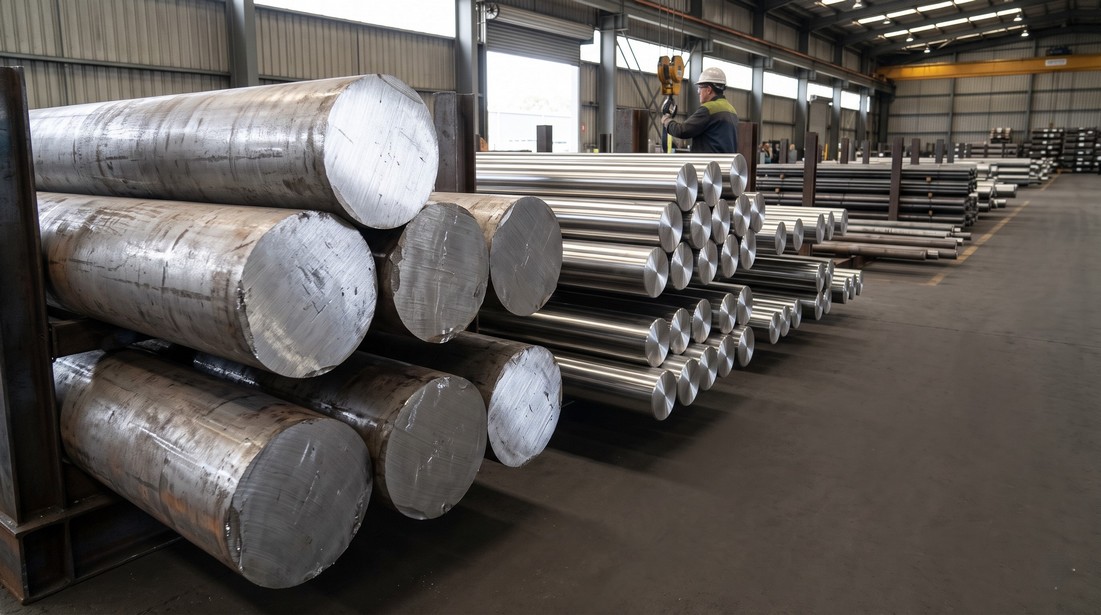
Steelmet Industries supplies Vacuum Degassed (VD-route) EN19 (AISI 4140) and EN24 (AISI 4340) in Cold Drawn Bright Steel Bars, peeled and ground bars, annealed forged rounds, and Hot Rolled Black Rounds. Every lot undergoes ultrasonic testing and ships with full chemical and mechanical test certificates under our Quality Policy.
Consult Our Metallurgical & Sales Team:
Corporate Website: www.steelmet.in
Request a Quote: Contact Steelmet Industries
